Let's Talk
Need advice on furnishing your space?
Tell us the sector, the space and the quantity, and we'll put together a tailored recommendation — no obligation.

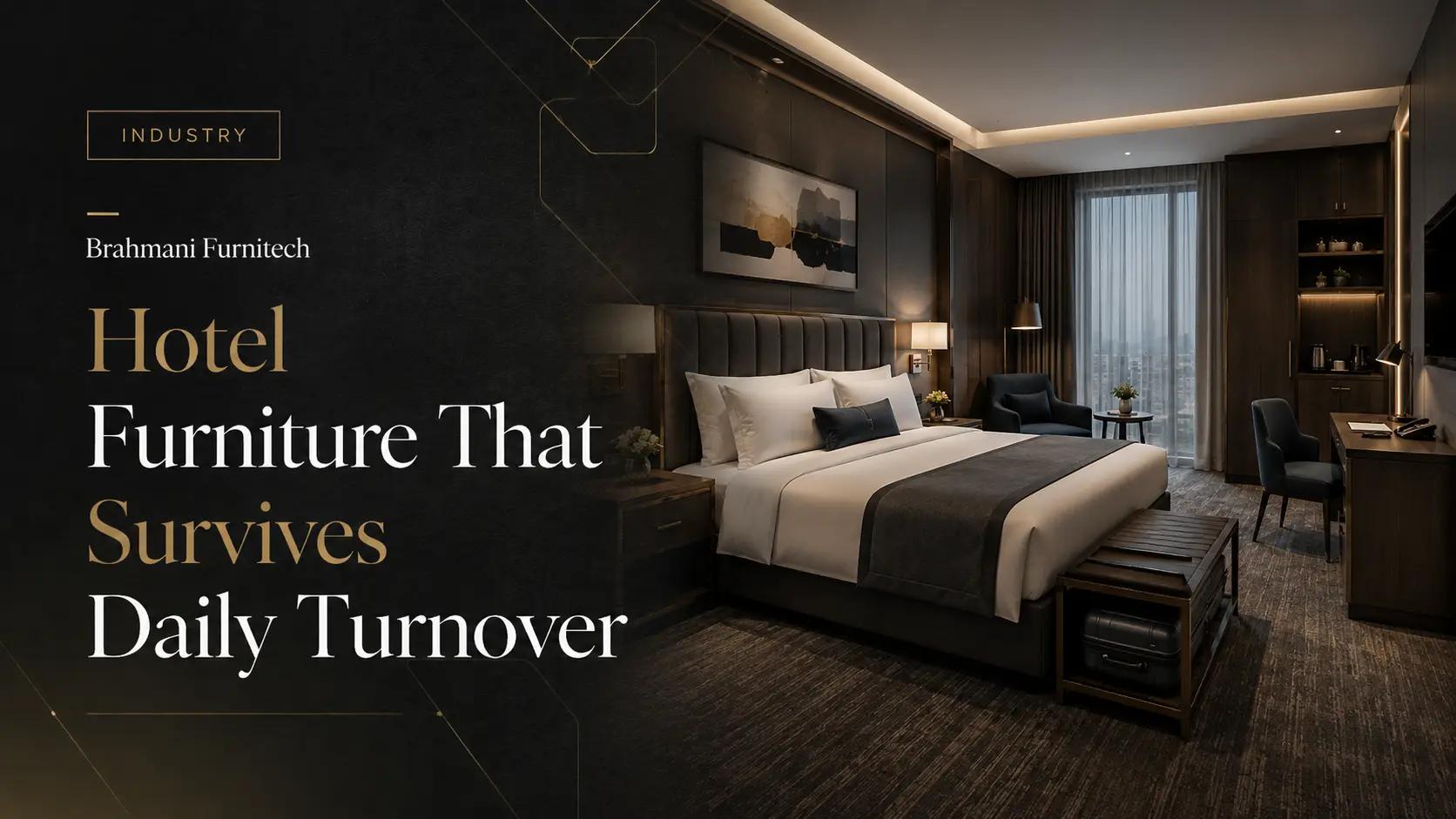
Furniture in a hotel is used by someone new almost every day, none of whom have any reason to be careful with it, and it is cleaned around that schedule by staff working to a tight turnaround. That combination is more demanding than most commercial environments.
Here is what tends to matter.
A guest has never used this room before. They will pull the chair out at an angle, sit down heavily, put a suitcase on the luggage bench and possibly on the desk, and lean back in a chair that was not designed for leaning back.
Furniture that assumes careful use will not last. The practical implications:
In a guest room, the same few points take almost all the damage: the leading edge of the desk, the corners of the wardrobe nearest the door, the front edge of the luggage bench, and the outer edges of the headboard.
Those points deserve the most robust treatment available — thicker edges, radiused corners and, where appropriate, a genuinely impact-resistant edge material. Specifying a better edge only at high-risk points is a reasonable way to spend the budget where it earns its keep.
The same logic applies to circulation in corridors and public areas, where trolleys are the main source of impact. A skirting-height buffer on the furniture, or simply keeping vulnerable pieces out of the trolley route, prevents a lot of damage.
Housekeeping has a fixed time per room. Furniture that is slow to clean will be cleaned less thoroughly.
That argues for continuous surfaces, minimal seams, and shapes that can be wiped in a single pass. It also argues for thinking about where dust actually collects — decorative ledges and reveals look excellent on handover and become a maintenance burden within a season.
Consider what happens underneath, too. Furniture on legs with reasonable clearance can be cleaned under; furniture with a low, closed base cannot be cleaned under, and a plinth that sits a few centimetres off the floor is the worst of both.
Upholstery in guest rooms should assume spills. Wipeable or replaceable covers, and seat pads that can be swapped without replacing the frame, keep a room serviceable.
Guest room finishes face a specific pairing of conditions: strong daylight during the day, and warm low-level artificial light in the evening. A finish should be assessed under both.
Direct sunlight over years will fade many surfaces, and the fade is uneven — the part of a desk nearest the window ages faster than the rest. Where a room has strong exposure, that is worth raising as a specification question rather than discovering later.
Under evening lighting, very cool-toned finishes can read grey and unwelcoming. Warm-toned or textured surfaces generally hold up better across both conditions.
Hotels refurbish in phases, and rooms come out of service one at a time. Furniture that can only be replaced as a matched set makes that difficult.
Two things help. First, favour designs where individual components — a seat pad, a desk top, a drawer front — can be replaced without the whole piece. Second, keep a written record of the exact specification, including finish references, so a matching replacement can be made years later. A small attic stock of the highest-risk items is often cheaper than a mismatched room.
Ask how long a given finish or component will remain available. In hospitality that question is worth more than a small price difference.
Furniture contributes to how quiet a room feels. Hard, hollow items resonate — a wardrobe door that booms when closed, or a drawer that rattles, is noticeable at night and reads as low quality.
Soft-close hardware on doors and drawers, felt pads at contact points, and adequate mass in panels all reduce noise. These are small specification details with a disproportionate effect on perceived quality.
For each item in a guest room, confirm:
If you are specifying for a property and want to talk through durability or phased replacement, we are glad to help.
Written by Brahmani Furnitech ·
Tell us the sector, the space and the quantity, and we'll put together a tailored recommendation — no obligation.